
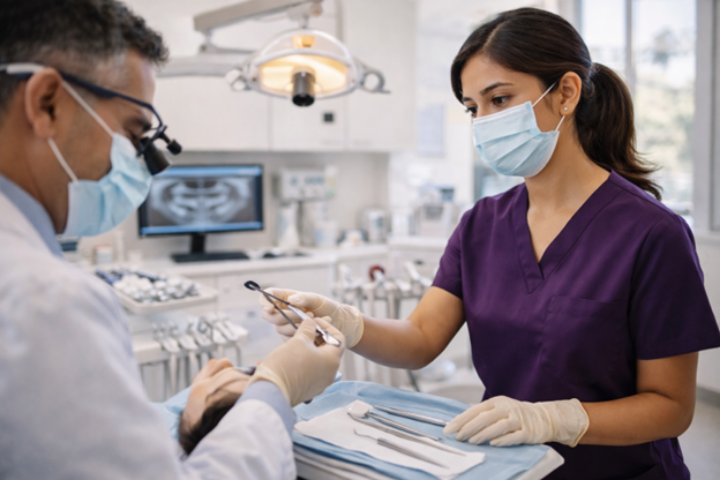
Wondering what dental assistants actually do during procedures? It's more hands-on than most people realize. You're not just watching from the sidelines—you're actively involved in patient care, working alongside the dentist to keep everything running smoothly.
If you're considering dental assisting as a career, understanding these common procedures gives you a realistic picture of what your days will look like. Let's walk through the clinical work you'll be doing.
Setting Up for Success: Treatment Room Preparation
Every procedure starts before the patient sits down. As a dental assistant, you're responsible for making sure the treatment room is ready to go.
This means organizing the specific instruments needed for each procedure—a filling requires different tools than an extraction. You'll set up trays so the dentist can work efficiently without searching for anything. You'll also prepare materials like impression compounds, filling materials, or bonding agents depending on what's scheduled.
It sounds simple, but good room setup directly impacts how smoothly procedures go. Dentists notice when their assistant anticipates what is needed. Over time, you'll learn to read the schedule and have everything ready before anyone asks.
Infection Control: The Non-Negotiable Foundation
Sterilization isn't glamorous, but it's one of the most important things you'll do. Every instrument that touches a patient must be properly sterilized. Every surface must be disinfected between patients. There's no cutting corners here.
Your infection control responsibilities include running instruments through the autoclave (a high-pressure steam sterilizer), wiping down all surfaces with hospital-grade disinfectant, properly disposing of contaminated materials, and maintaining sterilization logs that document everything.
California takes infection control seriously. The Dental Board requires dental assistants to complete approved training, and NCC's program includes Infection Control certification so you graduate ready to meet these standards.
Taking Dental X-Rays
X-rays are one of the most common procedures you'll perform, and in California, dental assistants can take radiographs under general supervision once they have Radiation Safety certification. This means the dentist doesn't need to be in the room—you handle it independently.
You'll work with several types of X-rays depending on what the dentist needs to see:
Bitewing X-rays are the most common, taken during routine checkups to spot cavities between teeth. You'll position small sensors inside the patient's mouth and capture images of the upper and lower teeth biting together.
Periapical X-rays show the entire tooth from crown to root tip. These are essential for planning root canals or checking for abscesses.
Panoramic X-rays capture the whole mouth in one image. Patients stand while a machine rotates around their head—no sensors inside the mouth. These help assess wisdom teeth, jaw alignment, and overall oral health.
Taking good X-rays requires technique. You need to position sensors correctly, angle the X-ray beam precisely, and help patients stay still. With practice, you'll get clear, diagnostic images consistently.
Safety matters here, too. You'll ensure patients wear lead aprons and thyroid collars, position yourself behind protective barriers, and follow protocols that minimize radiation exposure for everyone.
Chairside Assistance During Procedures
This is where dental assisting gets dynamic. When the dentist is working on a patient, you're right there—passing instruments, managing suction, retracting tissue, and keeping the field clear.
During a filling, for example, you might prepare the composite material, hand the dentist instruments in the right sequence, use the suction to keep the area dry, and cure the filling with a specialized light. Good chairside assistants develop a rhythm with their dentist, anticipating what's needed before being asked.
You'll also help keep patients comfortable. Many people feel anxious in the dental chair, and your calm presence makes a difference. You might explain what's happening, offer reassurance, or simply adjust the chair so they can relax.
The procedures you'll assist with vary by practice. General dentistry offices focus on cleanings, fillings, and extractions. Specialty practices might involve orthodontic adjustments, oral surgery, or cosmetic procedures. The core skills transfer across all settings.
Dental Cleanings and Coronal Polishing
Dental cleanings are a team effort. While hygienists typically perform the deep cleaning, dental assistants with Coronal Polishing certification can polish teeth after plaque and tartar removal.
Coronal polishing involves using a slow-speed handpiece with a rubber cup and polishing paste to remove surface stains and smooth the tooth enamel. It's the finishing touch that leaves teeth feeling clean and looking bright.
You'll also assist during cleanings by preparing the treatment room, passing instruments, providing suction, and helping patients rinse. Throughout the process, you're watching for signs of patient discomfort and keeping the appointment running on schedule.
NCC's program includes Coronal Polishing certification approved by the Dental Board of California, which expands what you can do from day one.
Helping Patients Feel at Ease
This isn't a "procedure" exactly, but it's central to everything you do. More than one-third of Americans experience some level of dental anxiety. Your ability to help patients relax directly impacts their experience and whether they return for future care.
You'll explain what's about to happen in terms patients understand. You'll check in during procedures to make sure they're okay. You'll offer small comforts—a blanket if they're cold, sunglasses if the light bothers them, or just a reassuring word when they look nervous.
The technical skills matter, but the human connection is what makes dental assistants invaluable to their teams.
Impressions and Other Clinical Tasks
Depending on your practice, you may also take dental impressions of mouth guards, whitening trays, or orthodontic appliances. This involves filling a tray with impression material, placing it over the patient's teeth, and holding it steadily while the material sets.
Other common tasks include placing and removing rubber dams (used to isolate teeth during procedures), applying topical fluoride treatments, and taking and recording vital signs. The variety keeps the work interesting—no two days look exactly the same.
Building Skills That Transfer
The procedures you learn as a dental assistant create a foundation for career growth. Many dental assistants go on to pursue Registered Dental Assistant (RDA) licensure, which allows for expanded clinical functions. Others move into office management, dental sales, or use their experience as a stepping stone to dental hygiene school.
Whatever direction you take, the hands-on clinical skills you develop are yours to keep.
Learn These Procedures at NCC
National Career College's Dental Assistant Program teaches you these procedures through hands-on training in our dental labs, not just textbooks. You'll practice on mannequins before working with real patients during your 160-hour clinical externship.
Graduates earn three certifications approved by the Dental Board of California: Radiation Safety, Infection Control, and Coronal Polishing. These credentials let you perform more procedures from day one, making you more valuable to employers.
Ready to get hands-on? Request more information about NCC's Dental Assistant Program and see if this career fits what you're looking for.
